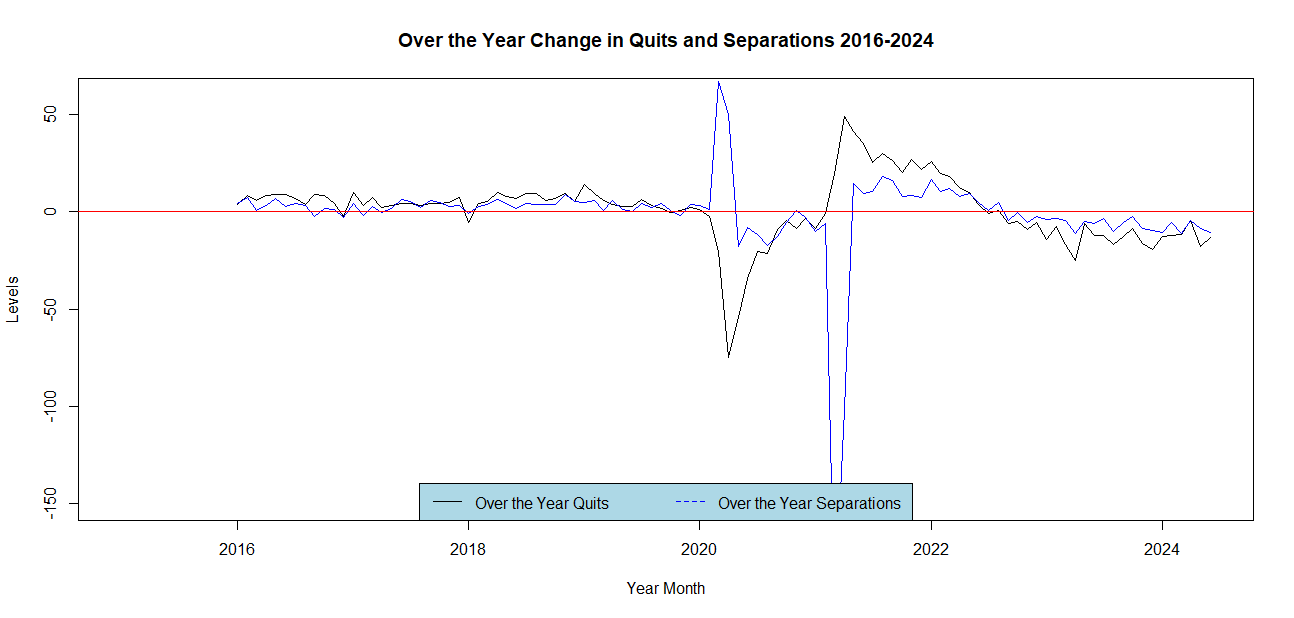
July 2024 marks two years of constant decline in frictional unemployment levels. Labor Quits Data continue to show employees are staying put, while Separations Data show employers do not easily let go of employees. Negative changes in the series suggest that the opportunity cost for the replacement of both employees and employers is high enough to make the labor market sclerotic. On the employer side, there seems to be little expectation that replacing an employee will lead to higher output. Simultaneously, there seems to be little expectation on the employees’ side that changing jobs will lead to a higher salary. The US Labor Market seems to be in a transitioning stalemate. Unfortunately, we do not know where this stalemate is heading.
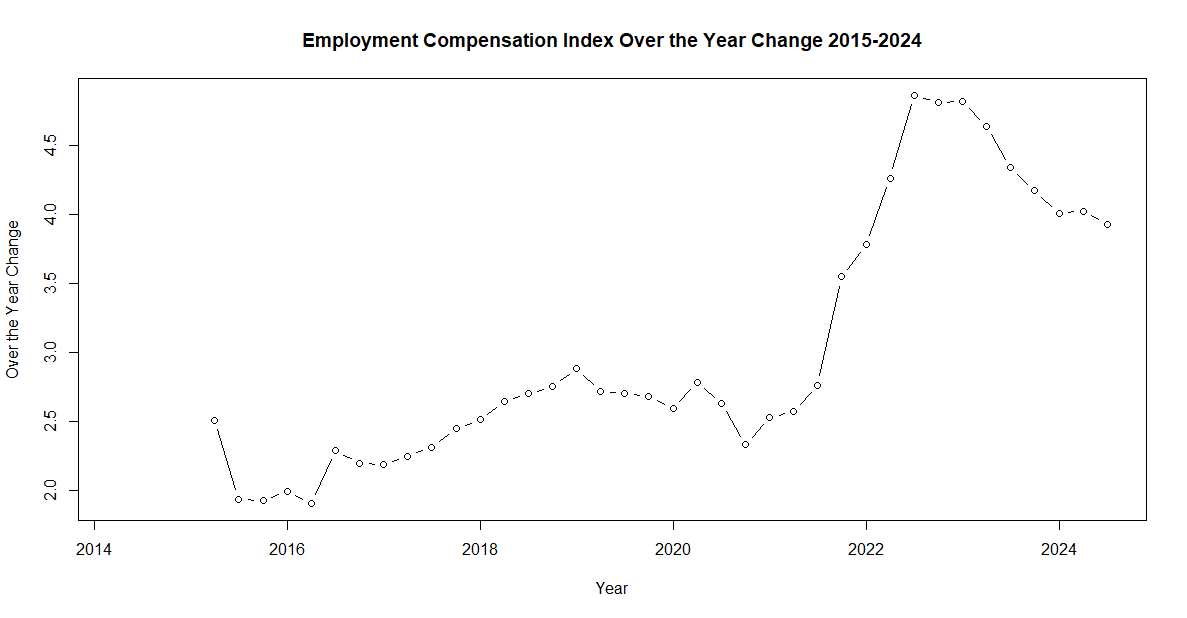
The driving factor behind the employment stalemate could possibly be the increases in wages and salaries experienced during 2023 (See Chart below). Although the market has softened, employers appear still hesitant about workers’ availability and may still see the market as challenging as it was a year ago. Data started to show that the tough labor market for employers is no longer the case.

Whenever changes over time are positive, labor economists expect that a healthy behavior of both metrics reflects, on the employees’ side, positive expectations on future employment, and on the employer side, positive expectation about output. Furthermore, what we learned from the Covid-19 Recession is that the two metrics’ correlation turns negative whenever things are either exceptionally good or awfully bad for both sides of employment. These recent data do not support any good expectations on either side.
Make an Appointment!


Categories: In the news., Macroeconomics


 Econometricus.co
1 reply »