Recent uptick in the Unemployment Rate may be a spillover of the so-called “Great Resignation”. The main effect of the phenomenon has been a tight Labor Market where employers struggled to find candidates and to retain employees. The tight Labor Markets of 2022 and 2023 gave most workers negotiation power on compensation, thereby increasing firm-wise costs for employers. Along with the cooling of the Labor Market, the industries that were affected the most may start to shed some of the highly compensated hires from the “Great Resignation” times. We tested data from thirty-four industries on compensation levels before and after to identify the ones that may adjust labor salaries as the Labor Market softens.
(Data Source: US Bureau of Labor Statistics, own calculations)
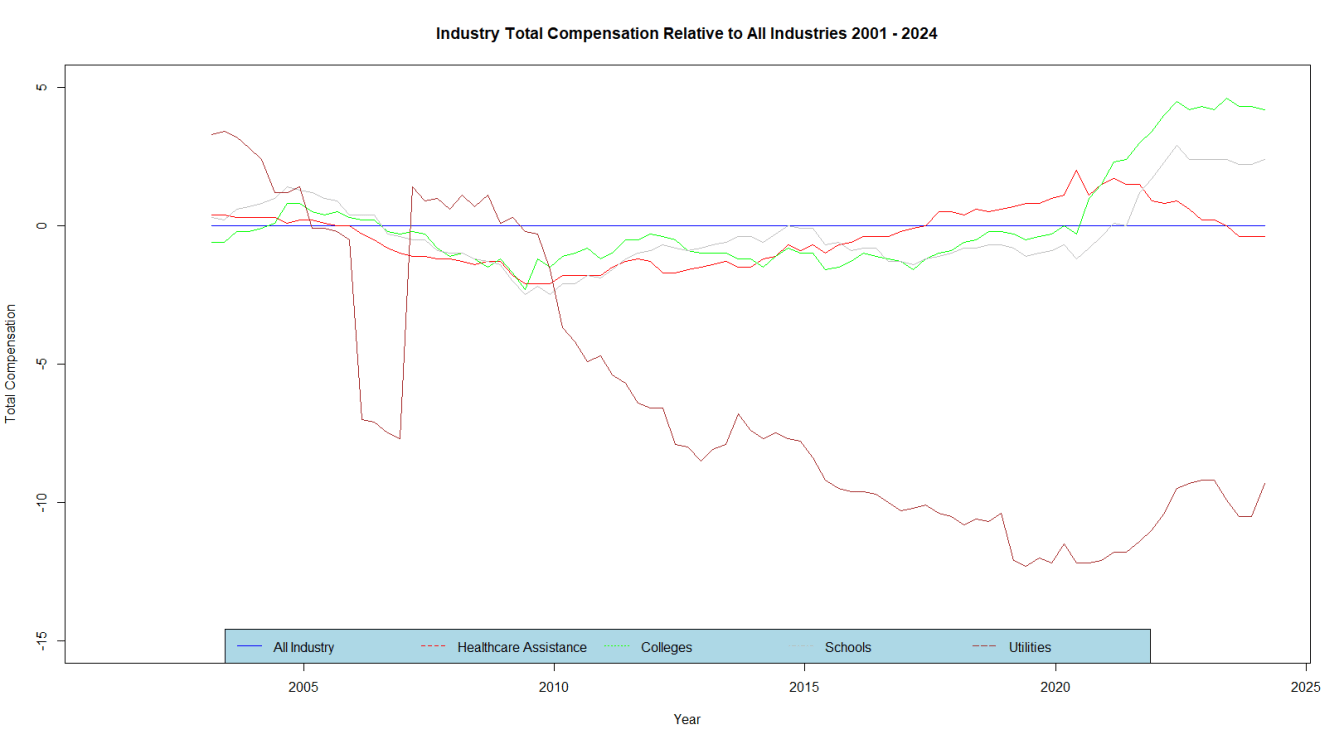
The industry that better contextualizes the case is Healthcare Assistance. The adjustments in compensation as the Covid-19 health crisis fades are visible in the declining red line on the chart above. At Econometricus, we believe that as Covid-19 shocks go away, most of Labor Markets will correct to levels like the pre-pandemic figures following Healthcare Assistance trend. In the chart we also depict Schools and Colleges notably showing increases in compensation after the “Great Resignation”.
The rationale for the test is that industries that increased their employment costs during the “Great Resignation” may be at risk of overpaying employees currently. To identify such a set of likely industries, we took the difference between the Index for all occupations in all industries and each of the thirty-four industries. Then, we tested for differences in the mean values of pre- “Great Resignation” compensation levels (Data before March 2021) and post- “Great Resignation” (Data after March 2021) compensation levels. The question we asked the data was: Is the current average in compensation higher than before the “Great Resignation”?
The table below shows the results. We believe industries where the current compensation is significantly higher than before the “Great Resignation” may be at risk of shedding some workers while labor markets ease as a consequence of restrictive monetary policy.
| Industry Name | P Value | Is the current average in compensation higher than before the “Great Resignation”? |
| Education Health Services | 0.0000 | Yes |
| Professional | 0.0000 | Yes |
| Scientific | 0.0000 | Yes |
| Colleges | 0.0000 | Yes |
| Education Services | 0.0000 | Yes |
| Information | 0.0000 | Yes |
| Construction | 0.0000 | Yes |
| Goods Producing | 0.0000 | Yes |
| Schools | 0.0000 | Yes |
| Manufacturing | 0.0000 | Yes |
| Elementary Secondary Schools | 0.0000 | Yes |
| Real Estate | 0.0000 | Yes |
| Non-Durable Goods | 0.0001 | Yes |
| Healthcare Assistance | 0.0002 | Yes |
| Durable Goods | 0.0006 | Yes |
| Aircraft | 0.0011 | Yes |
| Hospitals | 0.0043 | Yes |
| Insurance | 0.0904 | No |
| Finance Comp | 0.1037 | No |
| Wholesale Trade | 0.2219 | No |
| Finance Insurance Comp | 0.2504 | No |
| Credit Intermediation | 0.9706 | No |
| Nursing | 0.9861 | No |
| Public Admin | 0.9971 | No |
| Waste Admin | 1.0000 | No |
| Other Services | 1.0000 | No |
| Transportation Warehouse | 1.0000 | No |
| Service Providing | 1.0000 | No |
| Utilities | 1.0000 | No |
| Hospitality | 1.0000 | No |
| Retail | 1.0000 | No |
| Food Services | 1.0000 | No |
| Trade Transportation | 1.0000 | No |



Categories: In the news., Macroeconomics


 Econometricus.co