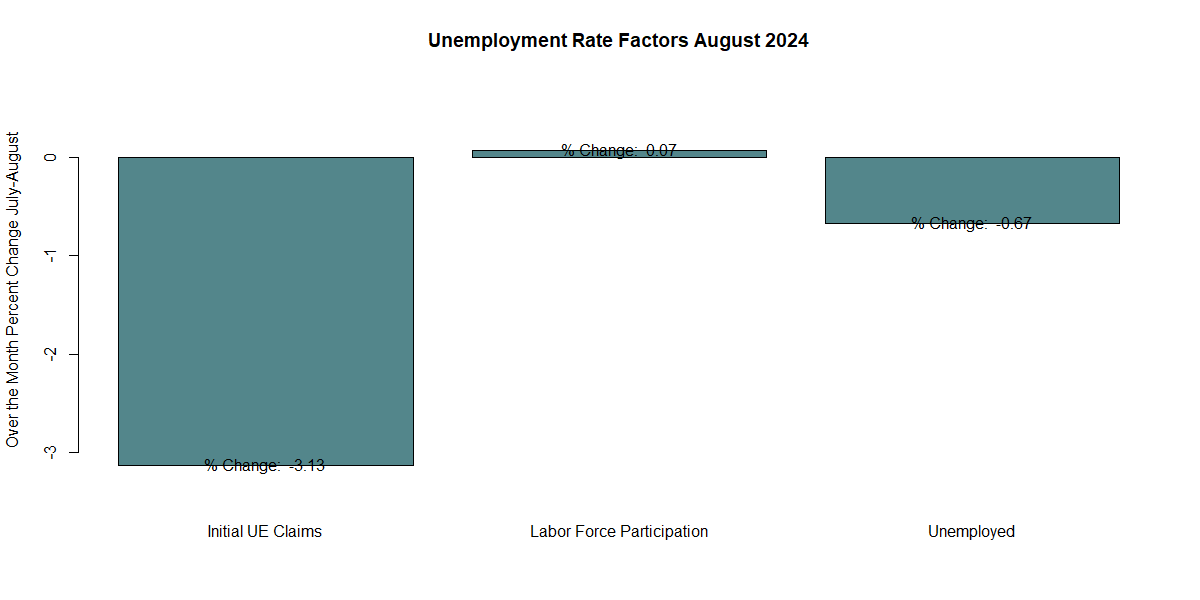
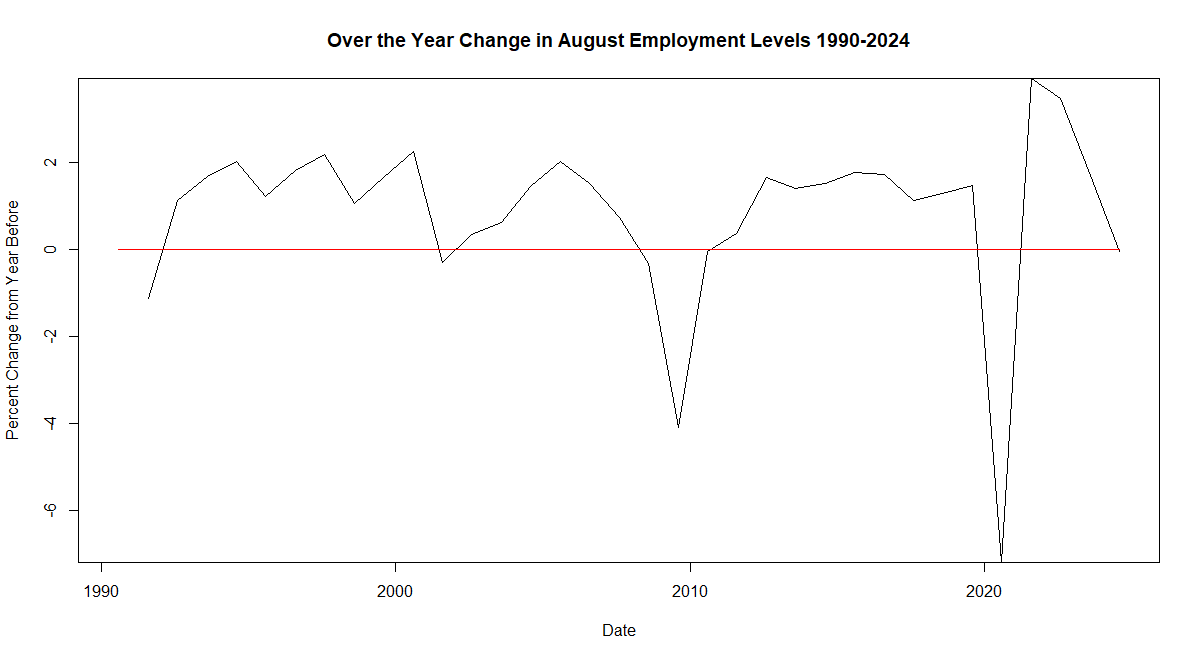
A stagnant labor market shows expectations of growth are neutral, thereby freezing employment growth. The current state of stagnation in the labor market has been visible in July and August’s stops in hiring and separations (retirees and quits). At the core, there seems to be a stand-by moment where workers are expectant on prices to adjust income, while employers are expectant on interest rates to adjust investment. U.S. Bureau of Labor Statistics’ Household surveys are showing the number of people looking for jobs declined in August, while a non-surprising lower number of Unemployment Insurance New Claims for the same month (see Chart 1 below) drove down the Unemployment Rate to 4.2%. The Labor Force participation remains almost unchanged. Although the Unemployment Rate slipped slightly down, data show the U.S. economy had the worst August Payroll Numbers since the Great Recession years 2008, 2009, 2010 (see Chart 2 Below). A slight change in expectations might lead to greater employment levels.
Chart 1 and Chart 2
Low levels of labor churn reveal that both employers and employees have low expectations of growth soon. On the employer side, expectations about profit may not be as good as needed to increase employment levels. And, on the workers’ side, expectations about income levels may be driving the need for extra work time. Simply put, employees may be thinking inflation will continue to eat up future income, while employers may be thinking that interest rates may continue to eat up profit.
The last three months have shown data ranging from spikes in unemployment due to increases in the Labor Participation Rate to lower levels of both Quits and Unemployment Insurance. The mixed signals in factors affecting the unemployment rate generate a noisy policy debate where panic of a downturn leads to premature conclusions. A simplifying view to understand the market is not enough to portray its current state: Stagnant. Tilting the assessment of the Fed’s monetary policy stance will be enough to encourage a break in the standoff. In fact, the U.S. economy may not need an interest rate cut currently, however, the Fed will have to deliver anyways.
Make an Appointment


Categories: Macroeconomics


 Econometricus.co
2 replies »