Inflation curbed down in August to 2.5 percent; however, the Shelter Index jumped up to 4.95 percent. The Shelter Consumer Price Index went up for the first time after twelve months of straight decline. Macroeconomists were confident that although the index has remained high, it will keep on falling steadily because of the current restrictive monetary policy. Consumer Price Index data for August 2024 shows a rebound in shelter prices of 0.51 percent over the month. The overall intuition looks at a Shelter Price Index trailing the effect of restrictive monetary policy given the overheated labor markets of 2022 and 2023. Today’s advanced data puts at risk an eventual cut in interest rates by the Federal Open Market Committee this upcoming 17th of September. This data release makes it difficult to gauge whether the labor market has cooled enough.
The Bureau of Labor Statistics’ reported data on headline inflation for the month of August read at 0.187 on month-over-month change basis, while 2.52 percent on year-over-year change basis. The Consumer Price Index increased by 0.032 percentage points over the month, and by -1.06 compared to the same month in the year 2023. The current year-over-year change is not significantly different from the average increases for the last fourteen years. The current month-over-month change is significantly lower than the average decreases for the last six months.
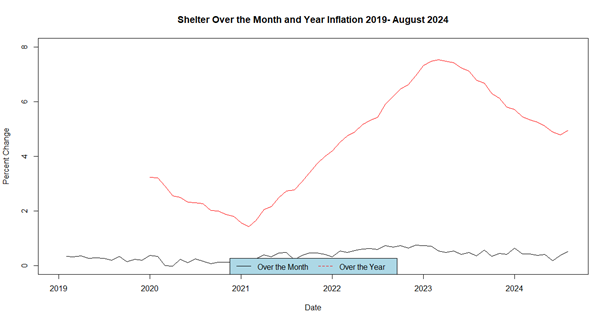
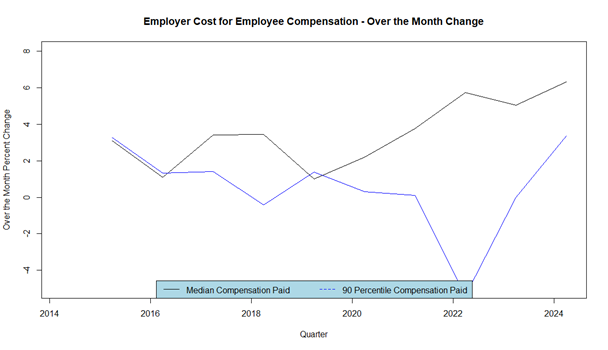
Shelter prices are highly correlated with wages and income. Such a relationship implies that high income and wages drive shelter costs up, and vice versa. Ever since the US labor market experienced the so-called “Great Resignation,” its spillovers from high levels of job quits have not ended, thereby driving workers’ compensation up. Such an unexpected increase in compensation, along with high interest rates, ends up pushing housing costs up. Thus, Hourly Real Earnings of civilian workers were up 3.6 percent compared to August 2023, while 0.22 compared to July. Weekly earnings for August were in the neighborhood of 3.3 over the year and 0.88 percent change over the month. Quarterly data on employer costs reflect the same trend where the increases take place for both the bottom half and the top ten of the earners.
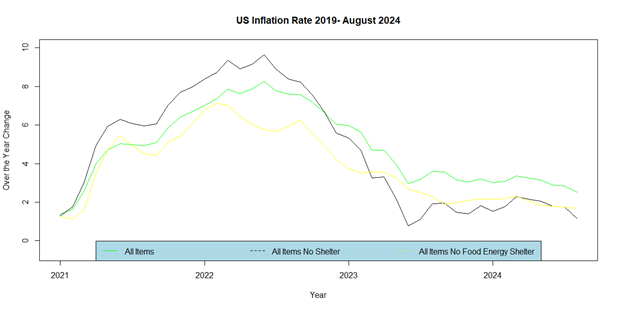
Thus, if the major driver of inflation rebounds while wages keep increasing, the upward risk of inflation remains higher than the upward risk of the unemployment rate.
Let’s talk to see how we can support your data analytics and reporting


Categories: Macroeconomics


 Econometricus.co